A selection of images taken by guests during their stay.  Page 2 of 3
Page 1 or Page 3
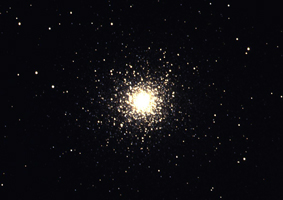
M15 and M45 by Jim Coughlan. September '08 Jim brought his own equipment with him and used a different camera for each of these shots. Details as follows. M15 = MX7C camera: 45 x 120 second exposures total 90 minutes. Captured with Astroart 4. M45 = QHY8 camera: 6 x 300 seconds + 6 x 600 seconds + 6 x 900 second
exposures total 3 hours. Captured with Nebulosity. M15 is a globular cluster in Pegasus and M45 is an open cluster better known as the Pleiades. |
|


M27 and M13 by Gerry Doyle. August '08 Gerry used a QSI ccd camera to take these images. This was probably the most sophisticated camera to be used on our Intes to date. Both are the sum of 20 x 150sec subframes - 5 each of LRGB. All stacking, calibrating and processing was carried out in Maxim DL. The thumbnails have been cropped to suit our site. M27, also known as 'The Dumbell' is a planetary nebula in Vulpecula
and M13 is a globular cluster in Hercules. |
   |
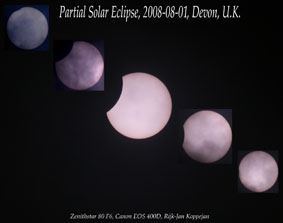
Partial Solar Eclipse by Rijk-Jan Koppejan. 1st August '08 While on a family holiday from Holland Rijk-Jan took this nice sequence of a partial eclipse of the Sun. The sky wasn't 100% cloud free but it was clear enough to capture most of the event. His 80mm refractor was carried on a tracking alt-az mount and a baader type filter was used. Rijk-Jan is related to the Philippus Lansbergen Observatory in Middelburg (The Netherlands) which this year, 2008, is marking the 400th anniversary of the invention of the telescope by Hans Lipperhey, spectacle-maker and inhabitant of Middelburg. Additional information can be found on their website. More of Rijk-Jan's images appear there. |
|
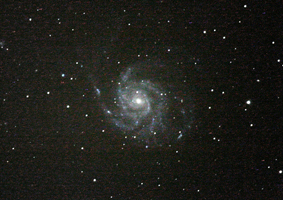
Summer Sky Greats by Rijk-Jan Koppejan. August '08 More images from Rijk-Jan. He took these pictures while on a family holiday from Holland. Our Intes and mount were used but no autoguider. Instead he used short, 2 minute exposures which were stacked (no darks or flats). Using this method he was able to cover a large number of objects in a short time. Shown below are just a few. We have cropped these to suit our site. |
      |
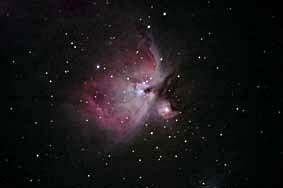
M42 and M81, M82 by Paul Hardy. 11th February '08 Using our Intes, Paul capture an image which highlights the outer regions and vast extent of the Orion nebula. He also produced this very nice image of the classic galaxy pairing, M81 and M82. Paul wrote - I have attached an image of the Orion Nebula, taken
during our stay on the 11-02-2008. This image consists of 6 raw files
converted to 16 bit tiff in Canon Photo Professional. They were then
stacked using Deep Sky Stacker, and final adjustments made in PS.
I have a book of images taken by Hubble, and used this as a reference
when adjusting colours etc. Many thanks to you both for your help
with the scopes, we both had a wonderful holiday and look forward
to returning later this year. |
|

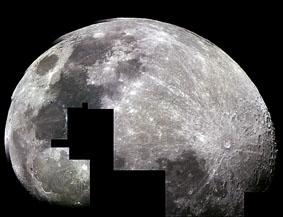
The Moon. by Reverend Kay. December '07 Reverend Kay bought her own web cam and laptop with her. Never having used the webcam before she produced this great montage, from many images, of a waxing moon as seen through our Intes telescope. It shows Tycho and its ray system very well and also the three prominent seas of Serenity, Tranquility and Fecunditatis. |
|
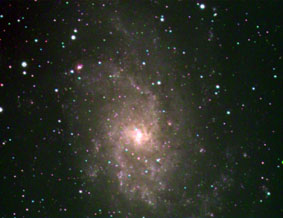
M33 by Jim Coughlan. October '07 Jim brought his own equipment with him and used it to produced this impressive image of M33 in Triangulum. |
|
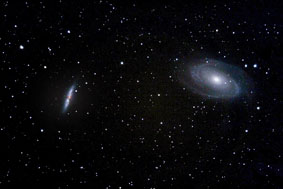
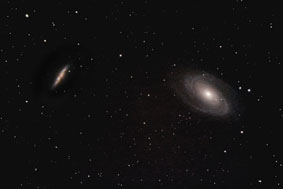
M31, M33 and M81 with M82 by Barrie Sheringham. These were some of Barrie's first images and he used Images Plus
to process the RAW files from his Canon. |
   |
Southern Splendors. M16, M8 and M17 by Dee Amos. Dee took these great pictures from the pathway in front of Jay Lodge.
The telescope was in Alt-Az mode and they are single frames. Dee removed
the IR filter filter in the camera herself, following info on the
net! Click any picture for larger versions. |
   |
Leo Triplet by Phil Moore. It consists of 6 x 4 minute exposures, 2 x darks and 6 x flats. They were captured in RAW mode and converted to 16 bit Tiff using Canon Photo Professional. Stacking was done using DeepSky Stacker and final adjustment was carried out in Photoshop. |
|

Comets Encke, C/2006 XA1 and Machholz. Tony specialises in imaging this type of comet and puts a lot of research and effort into achieving these images. |
|


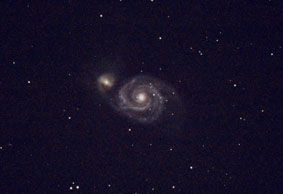
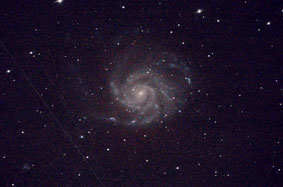
| M51
and M101 by Paul Gibbons. Intes MN71 - 18cm f6 Maksutov-Newtonian. EQ6 Pro SynScan mount. Pentax *ist DSLR. 20th March '07. Taken at the prime focus of our Intes telescope and EQ6 mount, Paul used our autoguider system to good effect to capture these images.They were each 6 x 4 minute exposures with 2 x darks. They were captured in RAW mode and stacked using DeepSky Stacker. Final 'tweaking' was carried out in Photoshop. The mount tracked superbly for 6 minute exposures but the images became too noisy so 4 minutes was chosen as a compromise between signal and noise.
|
|
| The Orion Nebula and Andromeda Galaxy by Russell King. The Orion nebula image is a composite of 3 separate exposures each of which captured different brightness levels within the nebula. The exposures were 10, 30 and 90 seconds. The three exposures were then blended together in Photoshop to produce this striking image. (click on picture for a larger size) The Andromeda Galaxy image is a composite of 4 identical images, each of around 2 minutes. These were then averaged together in Photoshop to reduce noise. Tonal detail was then improved by adjusting the levels, again in Photoshop. Photoshop work by Tony Gibbons. |
|